The Superpower Nobody Caught
A billionaire says my kind of brain wins the AI era. I feel it firing across four projects. I also wish someone had caught it forty years sooner.
A billionaire stood on a stage and described my brain.
Palantir’s billionaire CEO says only two kinds of people will succeed in the AI era: trade workers, or the neurodivergent.
That was the Fortune headline in March. Alex Karp, the CEO of Palantir, talking to Gen Z about how to future-proof a career.
I read it and felt something I don’t usually let myself feel.
I felt special.
I felt capable.
I have one, two, three, four projects going at the same time right now, and instead of the usual guilt about all the things I’m not finishing, I felt like the wiring was finally the right wiring for the moment. I got pretty frigging excited.
That feeling matters, because it is not the one I’m used to.
The same brain that loses a day to the wrong tunnel
I’ve written before about what this brain actually does to me.
It hands me twenty urgent things before my feet hit the floor and won’t rank a single one. It picks the interesting tunnel instead of the important one. It built a website all day when I was supposed to be doing the financials for my court case.
That brain is not a superpower on those days. It’s a tax.
So I want to be honest about what changed, because nothing about the wiring changed. The flood is still the flood. The tunnel is still the tunnel.
What changed is that something finally started paying the tax for me.
What AI actually removed
Here is the thing about a brain like mine.
I’m good at the spark. I can go into a thought, a fleeting one, the kind that used to evaporate before lunch, and now it doesn’t evaporate. It gets built in front of me.
The part I was never good at is the boring middle. The execution. The grind. The mundane, unglamorous, nobody-is-making-me-do-it work that sits between an idea and a real thing. My wiring physically refuses to pick that up. It always has.
AI eats the boring middle.
That’s the whole unlock. It’s not that I got smarter or more disciplined. It’s that the gap between the thought and the thing collapsed, so the spark finally survives long enough to become something.
Let me show you what that looks like in real life.
Four projects and a sentence from a friend
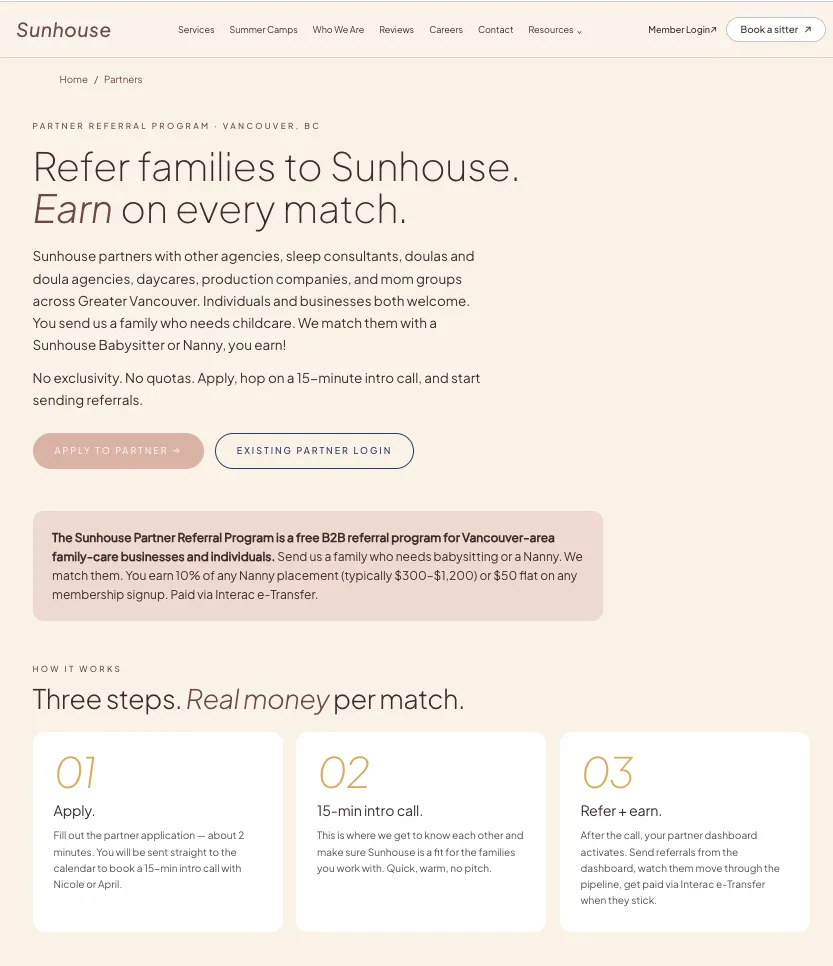
My friend Nicole Hughes, the co-founder of Sunhouse, had been talking about a partner page for her babysitting company for weeks. She also kept circling a bigger idea, that she could build a better solution for herself and for people in her whole industry.
So I had her do the one thing I’m bad at. I got her to document it. Write down what she wanted. Map the flow.
Then I did the part I’m good at. I expanded on it.
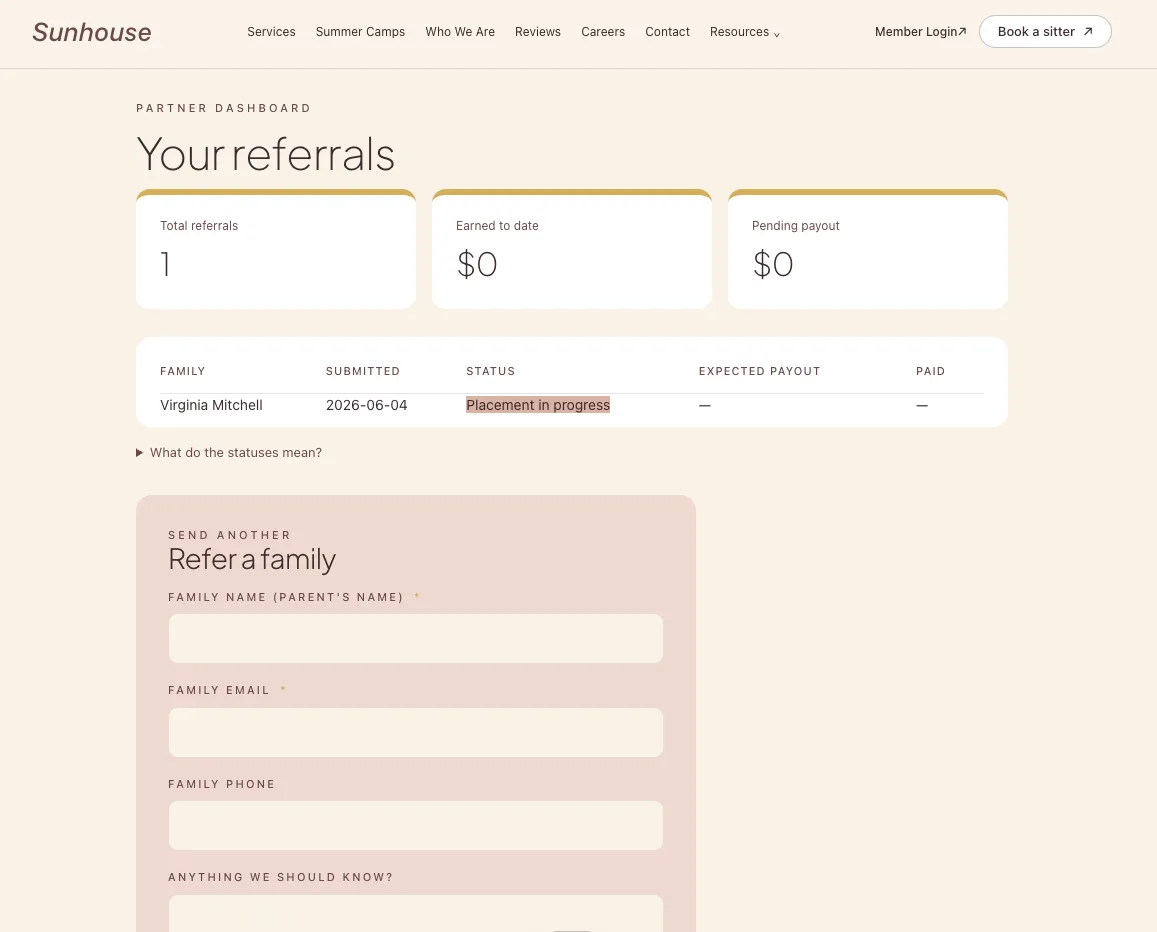
Now there’s a live partner portal. You can log in. You can track every referral. You can see whether your referral is going to pay, and when you’re getting paid. A few weeks of her talking, and then it just exists.
Then she mentioned doulas.
One of her friends, a doula, said she wanted a platform where she could make SEO-enabled websites, ones that are public, that link back, that actually get found. So I built that too. Now there’s an admin dashboard where a doula can log in and run the whole thing as a platform for herself. It just starts working.
That’s Doula Pages. That’s the Sunhouse portal. There’s BlueCollarPicks. There’s my family stuff.
Even my own voice is a tool now. I run Wispr Flow, and the profile it built for me literally calls me a “Product Juggler.” It says voice is my go-to tool for keeping multiple projects moving at once. My brain talking out loud, the thing that used to just be noise I couldn’t sleep through, is now how the work gets done.
At first all of that feels overwhelming. Four things at once, all lit up.
Now it feels pretty incredible.
And it’s great to hear someone like Karp say it out loud, because most of my life nobody was saying it.
The part underneath the excitement
I was talking with a friend recently.
He’s debating whether to put his kids on medication.
I don’t love the idea of medicating kids. You want them to have a good, clean life. I’m not going to sit here and tell another parent what to do with their child.
But the conversation pulled something up in me that I wasn’t expecting.
What I actually said to him was that I wish someone had identified the ADHD in my life early on.
I want to be careful here, because the easy version of this story is “I’d be so much better off.” That’s not true. I’m in a good place right now. I like who I’m becoming.
The real version is quieter than that.
It took me a lot of years to figure out who I was. For a long time I felt lost. Confused. I’d walk through life understanding one thing and having no idea about the next. I felt like an outsider my whole life. I didn’t connect with people, and I didn’t know how to, because I was always on a slightly different wavelength than the room I was standing in.
I got here. But I got here the long way, and I got here late.
The window from nine to twelve
Here’s the part that actually keeps me up.
I have an eleven-year-old daughter.
The years from nine to twelve are when a kid builds the thing that lasts. The persona. The drive. The quiet belief underneath everything that says I can do anything.
I think I may have missed that window for myself.
Not because the wiring was wrong. The wiring was right the whole time. I just spent those years, and a lot of years after them, thinking something was off with me, when the truth was that nobody had handed me the name for how I worked.
And that’s what makes his question land so differently than a headline about Davos.
Because the real stakes were never on a billionaire’s stage. The real stakes are in a house, with a kid who is nine, or ten, or eleven, right now, in the exact window that builds them, either learning that their brain is a problem to manage or learning that their brain is the most interesting thing about them.
That’s the difference between catching it and missing it.
It’s not really about medication. That’s the conversation everyone wants to have, and it’s the smaller one. The bigger one is whether a kid gets to know who they are during the years that decide who they become.
What I actually take from the article
So here’s where I land on the billionaire.
He’s right. My wiring is built for this moment. I can feel it, four projects deep, watching thoughts turn into real things faster than I’ve ever been able to make that happen.
And I’m grateful to hear it. When you spend a lifetime being hard on yourself, seeing your own superpower through someone else’s eyes does something for you. It’s healing. It really is.
But the applause is also forty years late.
It doesn’t give back the years I spent feeling like an outsider on the wrong wavelength. It can’t go back and tell the nine-year-old version of me that he wasn’t broken, he was early.
What it can do is make me pay closer attention to the eleven-year-old in my own house, and to a friend sitting across the table trying to make the same call for his kids.
Get them the name for how they work. Do it now. While the window is open.
That’s the part I’d never want anyone to catch too late.
Builder’s Note
If you’re neurodivergent, or you think you might be, you probably know exactly when you finally got the name for it. And you probably know how many years you spent before that thinking something was just wrong with you.
So here’s my real question for you.
If you could go back and tell the nine-year-old version of yourself one true thing about how your brain works, what would it be? And is there a kid in your life right now, in that same window, who needs to hear it before they spend years learning the wrong story about themselves?
I’d love to hear it. I’m still learning how to say it to mine.
A note: the Wispr Flow link above is an affiliate link. If you sign up through it, I may earn a little, at no cost to you. I only link tools I actually use.